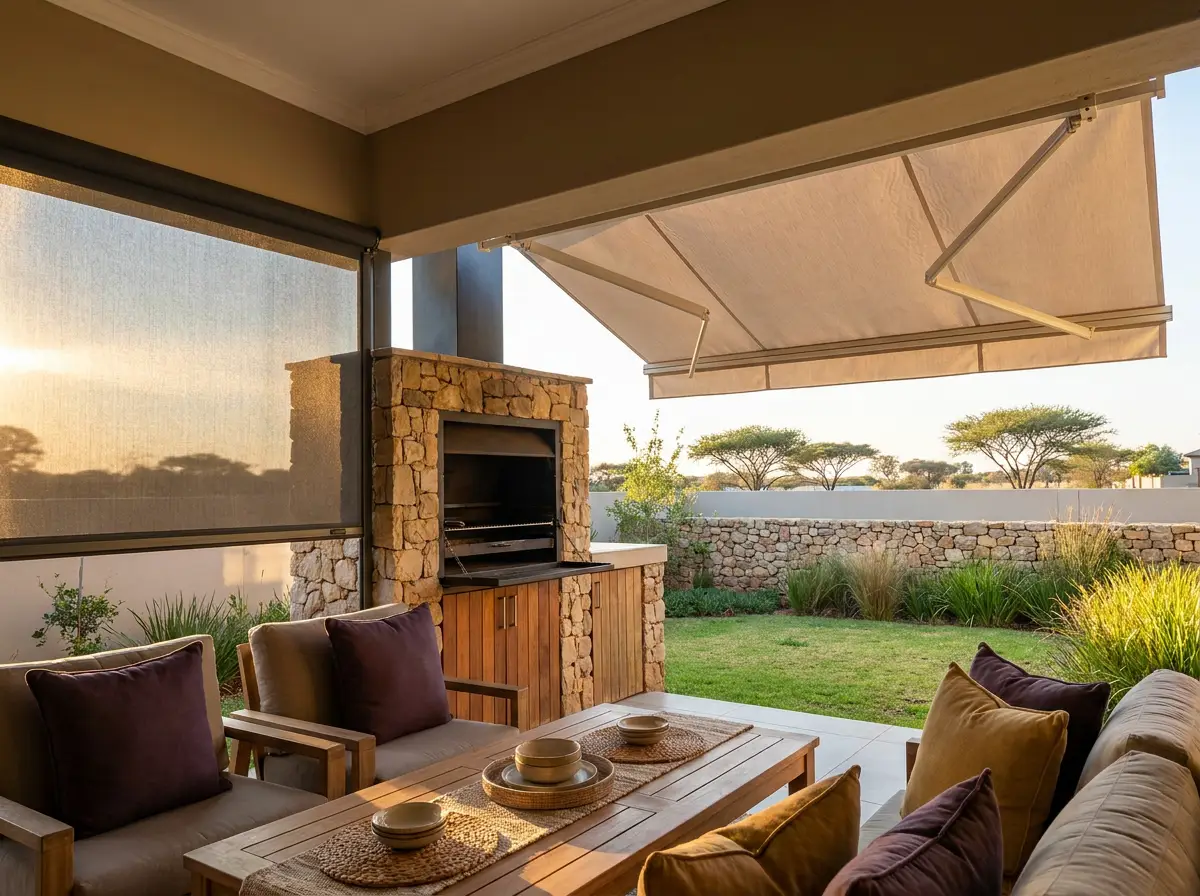
Shade On Demand, Gone When You Don't Need It
A folding-arm awning turns a baking north- or west-facing patio back into a usable room through the highveld summer, and retracts to let the welcome winter sun back in — the seasonal argument a fixed roof simply can't make. With no posts to interrupt the view or the braai space, it disappears into a cassette against the wall when you're not using it. Projection runs to roughly a 3–4m class over a wide span, and solution-dyed acrylic fabrics are chosen specifically to hold their colour under South African UV.
Motorised With A Wind Sensor — The Responsible Spec
Crank handles still work well on smaller awnings, but motorisation paired with a wind sensor is what we'd call the responsible spec for anyone on this estate. Pretoria East's October-to-March storm season brings sudden gusts that can catch an awning open and damage it badly; a wind sensor retracts the fabric automatically before that happens, protecting what is one of the higher-ticket items in the whole range. Full cassette options seal the fabric and arms away completely for extra weather protection, with semi-cassette or open mounting as lighter alternatives. LED lighting and a vertical drop-valance are worthwhile add-ons on premium installs.
Honest Limits
An awning is a shade product, not a rain product — it will shrug off light drizzle at a pitch, but it isn't built for a highveld downpour or standing water, and we won't tell you otherwise. Wind ratings are real engineering limits, not a suggestion, which is exactly why the sensor matters. And because the fixing substrate — brick, timber fascia or steel — changes how an awning is mounted, a proper site assessment at your free measure is non-negotiable before we quote.