Cordless cellular honeycomb blinds lowered at varying heights over a double-volume stairwell window in a new Six Fountains estate home

Free area guide · Six Fountains

The Six Fountains Light & Water Field Guide

Sun, glare & glass — window by window, for the estate on the three lakes

A Six Fountains stand is built around glass: stacking doors onto the patio, double-volume stairwells, and living rooms turned to face the water. That's exactly what makes the afternoon light a problem by mid-year. Here's what the Highveld sky actually does to a Six Fountains floor plan, elevation by elevation, with the trade-offs written down rather than glossed over.

About 8 minutes to read Written August 2026 Free — no email needed to read it Sources at the foot
One

Why Six Fountains is its own brief

Most shading advice is written for a flat with one wall of glass. Very little of it survives contact with a Six Fountains stand.

Six Fountains is a security estate of more than a thousand homes in Pretoria East, next to Silver Lakes, and it was laid out around three lakes and wetland conservation areas rather than around a road — the walkways, fishing spots and birdlife along the water are the reason people buy here in the first place.8 It is also still filling in: a finished render-and-glass home often stands next to a bare stand or a half-built shell, with young landscaping rather than mature trees to lean on for shade.9

That creates two very different jobs for us. One is upgrading a home that's already lived in; the other is specifying a house before the painters arrive. The newer stock leans on the same architectural language across most of Pretoria East — open-plan living, a double-volume stairwell, and floor-to-ceiling stacking doors linking the kitchen-living space to the patio and, wherever the stand allows it, to a lake view.9

A young estate is still choosing its character. Every blind either matches the house that's already there, or sets the tone for the one going up next door.

So the question here isn't really "how do we cover the window." It's how to keep those doors open to the water and the sky without the room cooking by mid-afternoon — and how to plan the tidy details, like a concealed blind box or motor wiring, while a new build's ceiling is still open. That's this guide.

Two

The light over the estate

Geometry, not opinion. Pretoria East sits at roughly 25°44′ South, about 1,300 m up on the Highveld, and because that's south of the Tropic of Capricorn the sun is in the northern sky all year — north-facing glass catches sun every single day.12 Four published numbers do most of the explaining:

  • Midsummer noon: the sun stands at about 87° — within a few degrees of directly overhead.1
  • Midwinter noon: about 40°, due north — low, and it stays low all day.1
  • Midsummer sunset at 243° — south of west, not due west.1
  • Midwinter the sun rises at 69° and sets at 295°, both north of the east-west line.1

Read it practically: the summer sun is the easy one and the low afternoon sun is the sneaky one. At 87° a modest eave, or even the estate's own landscaping, shades a north window at noon in December almost for free — nobody phones us about midday. But sunset swings across a wide western arc through the year, from 243° in December to 295° in June, and arrives almost flat by three or four o'clock,1 which is precisely when the low winter sun slides in under that same eave and reaches metres across the floor. West-facing glass, and the wide stacking doors so many stands here put on the afternoon side, take that head-on.

Then the Highveld adds three facts that change the specification. Hail is concentrated over Gauteng and the Highveld, most frequent from mid-November through February and peaking in the afternoon, roughly 13:00 to 17:003 — exactly the hours a patio awning is most likely to be out. Storm season proper runs October to March, in fast, heavy late-afternoon downpours.5 And UV rises about 10% for every 1,000 m of altitude,6 so at ~1,300 m, under some of the highest UV levels measured in the country,7 fabric fading is a year-round problem — Pretoria runs to roughly 3,200 hours of sunshine a year.4 Winter, by contrast, is dry and frosty at night,4 which is the honest argument for not blocking that low June sun for good.

Open-plan Six Fountains living room with floor-to-ceiling stacking glass doors onto a reed-lined estate lake, a blockout roller blind part-lowered against the bright afternoon sun
The lake-facing living room. The view is the point of the stand — the job of the blind is to keep it while taking the sting out of the afternoon light and the glare bouncing off the water.
Three

Elevation by elevation

Take a compass to each room before assuming anything — on a lake-oriented stand the house is often turned to the water rather than to the street, so orientation can't be read off the road. Four elevations, and a fifth problem the lakes add.

North

Sun every day of the year

Strong, largely unobstructed north light — generous in winter, punishing at the top of summer.1 The mistake is over-specifying: heavy blockout throws away free June warmth along with the January glare. North wants something you can tune through the day, not a permanent switch-off.

West

The expensive elevation

From early afternoon the sun swings toward that 243–295° sunset arc and keeps dropping.1 No eave shades it, because the light arrives from underneath — and a wide stacking door on this side turns an open-plan living area into a greenhouse by mid-afternoon. Where you stop the heat matters as much as what you stop it with.

East

Glare, not heat

The mirror image of west, but against cool overnight air and cool masonry, so it rarely becomes a heat problem — it's a first-light problem instead. An east bedroom or breakfast room takes a hard, low hit at sunrise and almost nothing after mid-morning. Solve for darkness at 5am, not for temperature.

South

Calm, with a privacy catch

Even, indirect light and the coldest rooms come June1 — the right wall for a study. On a stand where the neighbour's build sits close, though, it's also the elevation most likely to look straight into next door's lounge. Here the brief is usually privacy and light quality, not sun control.

And then: the light off the water

The three lakes are Six Fountains' best feature and a genuine, estate-specific shading problem. Open water throws a second helping of glare — low, bright and bouncing up off the surface — into any living room turned to face it, on top of whatever the sun is already doing to that elevation. It's the reason a lake-facing lounge that feels fine on paper can be unusable at certain hours, and the reason "cut the glare but keep the view" is the single most common request we hear on this estate.

A sunscreen mesh roller blind half-lowered over a wide lounge window at Six Fountains, the estate lake still visible through the open-weave fabric
Glare off the water, view kept. An open-weave sunscreen mesh cuts the bounce off the lake and much of the UV while the water stays legible through it — the trade-off is that it reverses after dark.

Optional

Want this marked up for your own home?

Tell us which rooms are the problem and we'll send this guide back with your own elevations noted against it — which windows we'd treat first, and what we'd weigh up on each. It's an email, not a visit. Nobody phones you about it.

POPIA: your details are used only to send you this guide and, if you ask for it, to arrange your free in-home measure. They are never shared or sold, and you can ask us to remove them at any time.

Four

What we'd fit here, and the catch with each

Each of these is right somewhere on a Six Fountains stand and wrong somewhere else, so each carries its reasoning and its honest trade-off — both ways, including cost in relative terms. Tap Add to my schedule on anything that sounds like your room; it carries straight down to the window schedule and the measure form, no retyping.

West & lake-facing glass that overheats

Roller shutters — stop the heat outside the glass

Rigid aluminium slats roll down from a headbox on the outside of the pane. That position is the whole argument: anything inside the glass still lets the pane warm up and radiate heat into the room, while stopping the sun outside means the heat never gets in. Half-lowered, a shutter takes the top of a tall window and leaves the bottom clear; closed, the slats and the trapped air behind them shade and insulate together.

The trade-off, honestly: it's the most expensive route here, it changes what's visible from the street — so it's an estate-approval conversation first (see section five) — and to be plain, these are shading shutters, for sun, heat and glare, not security-rated shutters, which are a different product we can quote on request. Where an external shutter isn't wanted, sunscreen mesh plus a blockout on a double bracket is the honest second best: less cost, meaningfully less heat control.

Lake-facing living rooms and dining rooms

Sunscreen roller blinds — cut the glare, keep the water

A single smooth flat sheet of open-weave mesh on a tube. It cuts the glare bouncing off the lake and much of the UV while the view stays readable through it — which matters, because the view is the reason the room faces that way at all. On a run of matching lakeside windows, specifying one fabric and openness across the whole elevation makes it read as a scheme rather than a row of separate fixes.

The trade-off, honestly: mesh gives daytime privacy only; after dark, with the lamps on inside, it reverses and you become the lit side. Where a room genuinely needs both view-by-day and dark-by-night, a double roller answers it — mesh in front, blockout behind — at the cost of a second blind on the bracket.

Bedrooms, especially east-facing

Blockout roller blinds — the reveal matters more than the fabric

The same flat sheet in a coated fabric that stops light rather than filtering it. On an east bedroom it buys back the sleep a Highveld sunrise steals — first light arrives hard and low from an azimuth as tight as 69° in winter.1 On a new build, though, almost no bedroom complaint is really about the fabric; it's light leaking around the edges.

The trade-off, honestly: there's no free option. Fitted inside the reveal the blind sits neatly in the opening and you accept a hairline of light each side; face-fixed over the opening it's far darker but covers the reveal; inside-fit with side channels gets you both, at the cost of one more component. Which one is right is a measuring decision, not a fabric one.

Where a neighbour's build sits close

Day/night roller blinds — dial privacy band by band

Two alternating fabric bands, one sheer and one solid, run past each other so you move from open view to full privacy without changing blinds — useful on the stands where a new house has gone up close enough to see straight into the lounge next door.

The trade-off, honestly: it's a light-and-privacy tool, not a heat tool — on a hard west elevation it won't do what a shutter or an external product does, and it isn't a true blockout for a bedroom. It earns its place on the middle-ground windows, not the extreme ones.

Double-volume stairwells and tall glass

Cellular honeycomb blinds — and motorise what's out of reach

Rows of hexagonal cells trap a layer of still air against the glass, so they insulate rather than just filter — real relief on the double-volume stairwells and tall windows this estate builds so often, which bake by afternoon and then lose their heat back out on a frosty winter night.4 Anything above comfortable reach wants a battery motor on it, so it's a button rather than a ladder.

The trade-off, honestly: cellular costs more than a plain roller for the same window and it doesn't tilt, so where you want to steer light rather than filter it a venetian is better. It also won't take scrubbing, so kitchens, sculleries and bathrooms get aluminium venetians instead.

Kitchens and bathrooms; and the traditional rooms

Aluminium venetians for the wet rooms; timber venetians for warmth

Thin tiltable metal slats are wipe-clean and shrug off the steam and condensation a fabric blind struggles with, and tilting them throws low afternoon sun up onto the ceiling instead of across the countertop — glare gone without losing the light. In a more traditional room, a timber venetian brings warmth and grain, and a tilt a roller simply can't offer.

The trade-off, honestly: a lot of slats means real dusting, and past about two metres wide we'd split the opening or motorise it. Timber is heavier again and wants keeping away from the wettest rooms — which is exactly why aluminium takes the kitchen and bathroom and timber takes the study or bedroom.

Wide sliding & stacking doors onto the patio

Vertical & panel blinds — stack clear of the opening

Vanes or wide fabric panels stack right off to one side, so a four- or five-metre stacking door onto the patio stays fully usable instead of sitting behind fabric bunched at one end. On the widest openings they split the span cleanly where a single roller would get heavy and bow.

The trade-off, honestly: a vertical vane aims low sun less precisely than a horizontal slat, and it's a lighter look than a roller or venetian — right for the door, not necessarily for the feature window beside it.

The patio, out at the lake edge

Folding-arm awnings — with a wind sensor, not as an extra

Hinged arms push the fabric out over the patio with no poles in the way of the furniture, and retract fully to let the low winter sun back onto the same paving in July — exactly what a Six Fountains entertaining area is built for. Motorising it is the same argument one step on, and a battery tube means no cable chased through a finished wall.

The trade-off, honestly: awning fabric is a consumable and a battery tube wants charging once or twice a year. And with Highveld hail peaking in the afternoon from mid-November to February,3 an automatic wind sensor here isn't an upsell — it retracts the fabric when nobody's home to do it. On a very exposed lake-edge stand a zip screen tensioned in side channels copes with gusts an open awning arm can't, which is a decision best made standing on the patio.

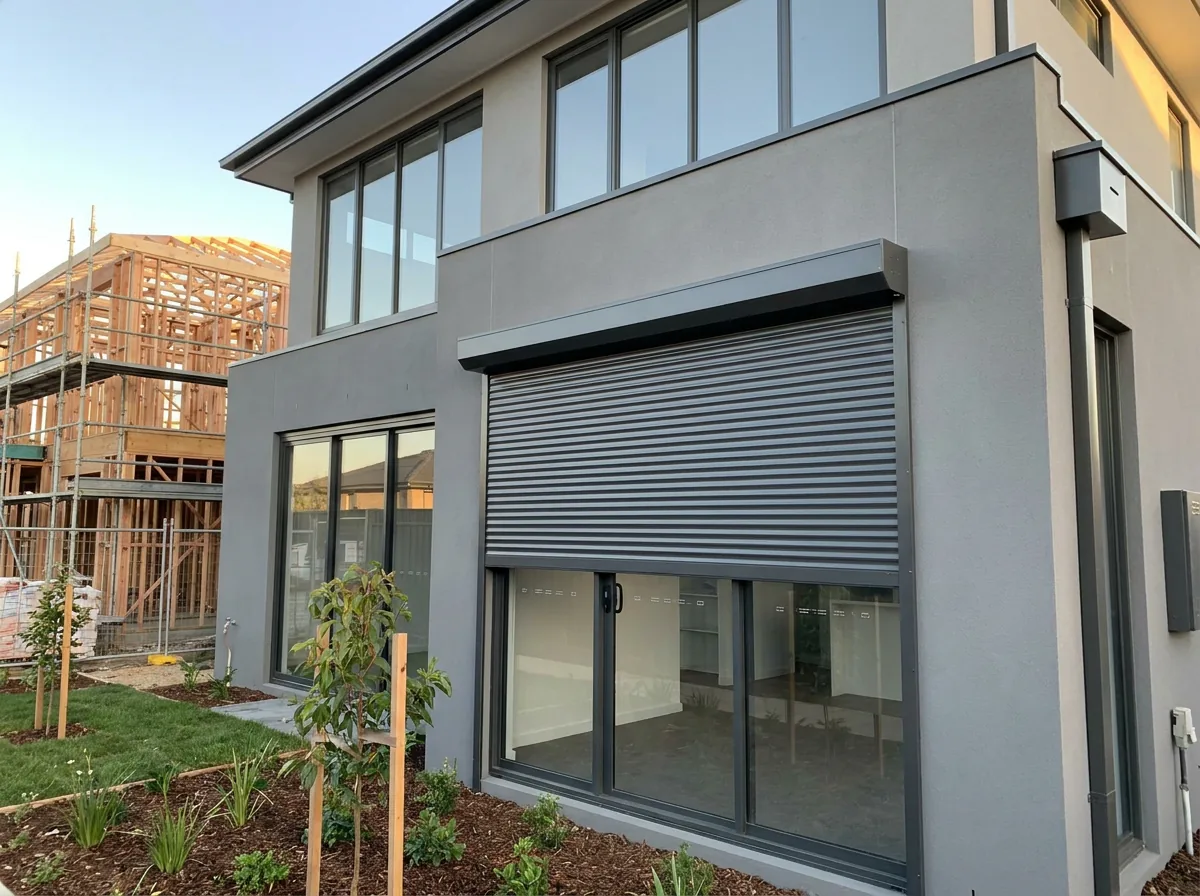
External aluminium roller shutter lowered partway over west-facing ground-floor sliding doors on a new double-storey Six Fountains home
Stopping it outside the glass. On a west elevation the strongest single move is an external roller shutter — sized for sun, heat and glare, cleared with the estate first, and never sold to you as security.

Four more, briefly

Concealed & recessed blinds

Fabric drops from a slot in the ceiling with no visible headbox — the clean finish for a new build's double-volume entrance, and far easier to plan while the bulkhead is still open than to retrofit after.

Skylight & shaped blinds

Gable windows, stairwell voids and roof lights — the odd-angled openings most quotes skip past, fitted to the actual shape and almost always motorised above reach.

Motorisation & automation

One remote, an app or a schedule for a run of blinds. Rechargeable battery motors keep working through loadshedding and need no wiring; a wired system needs its own backup power, and we'll say which suits your home plainly.

Blind repairs & re-cording

A snapped chain, a tired cord, a motor that's stopped answering its remote — most of it is a repair, including on blinds we didn't fit, and we'll say so honestly rather than quote you a whole new unit.

Tap the buttons above and what you pick lands on your window schedule and the measure form below — no retyping. Go to the window schedule ↓
Five

The estate's own rules

Six Fountains is a new estate, so there's no heritage overlay here — nothing is protected by a formal heritage listing. The constraint that actually bites is the estate's own architectural and aesthetic control. Security estates like this one run guidelines on anything visible from the street or a common area, and Six Fountains is tightly access-controlled, with dual guarded gatehouses, biometric entry and separate registration for owners, tenants and contractors.8

An internal blind, inside your own reveal, is a furnishing decision. Anything fixed to the outside of the house is an estate decision.

In practice that means a roller shutter headbox, an awning cassette, a colour that doesn't match the render — anything an outside eye can see — is worth clearing with your HOA or managing agent before you order, not after. A blind fitted inside your own reveal changes nothing anyone outside can see, and in most schemes is nobody's business but yours. We could not find Six Fountains' published manual for aftermarket blinds and shutters online, so if your trustees hold a documented colour or fixing rule, tell us at the measure and we'll work to it from day one. What we can do is specify slim profiles and quiet colours and supply the drawings and product data an application needs; the sign-off itself sits with the estate, not with us — we won't call it a formality.

One more, if you're renovating rather than fitting new. The current energy standard, SANS 10400-XA:2021, raised the glazing-to-floor-area threshold that triggers an energy calculation from 15% to 20% and dropped the older rule that judged west-facing glass more harshly than north or east.10 If you're opening up a floor plan with more glass than the original plan had, it's worth checking against the current 20% figure rather than an older number a previous owner may have worked to.

Six

What only a site visit answers

All of that is true of Six Fountains. None of it is true of your stand until somebody stands in it — and any one of these five can change the recommendation:

  1. The actual reveal depth, on a new build. Aluminium stacking doors and framed openings take different fittings, and even within one house type the reveal varies. That single measurement decides inside-or-outside fit — which decides whether a nursery actually goes dark.
  2. True orientation, room by room. Lake-oriented houses are often turned to the water rather than to the street, so the compass, not the floor plan, decides what a window really needs — and everything in sections two and three depends on getting it right.
  3. Wind exposure at your specific stand. A patio out on an open lake edge catches weather a walled-in interior stand never sees. The general hail pattern is published;3 your patio's orientation and shelter are not, and they decide whether a wind sensor is a nice-to-have or non-negotiable.
  4. What you're allowed to fix externally. Whether the estate will sign off an external shutter or awning on your elevation, and in what colour, is a conversation to have before you order — we'll write it up for your trustees in plain language.
  5. Power routing and the build stage. Whether a plug is within reach of a motor's charger, whether a concealed blind box can still be planned before the ceiling closes, and where the wiring wants to run — all far tidier to settle before the painters arrive than after.

That's the honest reason the measure exists, and why it's free: better to find these out before quoting than after fitting.

A folding-arm awning extended over a paved patio at the edge of a Six Fountains estate lake, with Highveld storm clouds building on the horizon
The patio question. Wind exposure and the sensor spec get decided standing on the patio with hail season in mind — not from a photograph.
Seven

Two ways forward — pick whichever suits you

One gets you an exact answer; the other a number to think about first. Both are free, and neither commits you to anything.

The straight answer

Book your free expert measure

A consultant comes to the house with fabric and slat samples, confirms access with your estate first, takes the compass reading rather than guessing it, checks the five things in section six, measures every window and leaves a written, itemised quote per window. We take five or six measure appointments a week across this area, so the diary fills early — no charge, no obligation either way.

What are you interested in? (tick any)
Want a ballpark figure first? Open this — about two minutes.
Six Fountains Blinds — window schedule Walk the house, fill this in by hand, then type it into the form on sixfountainsblinds.co.za. Measure the opening itself, width first, in millimetres.

Pop in rough sizes and we'll send a budget range by the next working day. Not sure how to measure? Leave it blank — our consultant measures for free and you get exact per-window pricing either way. Nothing here is binding, and nothing is priced from it.

Room Width (mm) Drop (mm) Inside or outside the reveal Product Remove

Nothing on the schedule yet — and it stays entirely optional.

Anything you enter here travels with your enquiry as plain text. No uploads, no third-party services, nothing stored anywhere else. If photographs would help, a consultant will simply ask for them in the reply.

POPIA: your details are used only to arrange your free in-home measure and consultation call-back, and are never shared or sold. If you tell us you're still researching, we won't call you. You can ask us to remove your details at any time.

Or, first

Want a ballpark before anyone visits?

Pop rough sizes into the window schedule inside the form and we'll send a budget range by the next working day. Not sure how to measure, or would rather not? Leave it — our consultant measures for free, and you'll get exact per-window pricing either way.

Plenty of people do both: rough sizes now, the measure after.

Our consultant does five or six measures a week across Six Fountains and the estates around it, so the diary fills early — worth booking ahead if you need a particular day.

Neither, for now

Just take the guide, marked up

Not ready for a visit or a number? Tell us which rooms are the problem and we'll email you this guide with your own elevations noted against it. Nothing is booked, nobody phones.

POPIA: used only to send you the guide, never shared or sold, removed on request.

References

Sources

Every factual claim above about the sun path, the Highveld climate and the estate comes from one of these. Where a figure came from a secondary source rather than a primary weather-station dataset, we've said so in the underlying research file rather than presenting it as more certain than it is.

  1. Gaisma — Pretoria sun & moon data (latitude ~25.7°S, ~1,300 m; June and December solar-noon elevations and sunrise/sunset azimuths).
  2. worlddata.info — Sunrise and sunset times in South Africa (Pretoria south of the Tropic, so the sun sits in the northern sky; noon elevations up to ~88° in December, ~40.8° in June).
  3. Kahraman, A. et al. (2023) — Characteristics of hail hazard in South Africa based on satellite detection of convective storms, Natural Hazards and Earth System Sciences 23, 1549–1565 (Highveld/Gauteng hail concentration, mid-November to February, afternoon 13:00–17:00 peak).
  4. Weather Atlas — Pretoria climate (~3,200 hours of sunshine a year; wettest November–March; dry, frosty winter nights).
  5. Flightline Weekly — Highveld Thunderstorms — Know the Dangers (October–March afternoon storm season).
  6. World Health Organization — Radiation: Ultraviolet (UV) (UV rises roughly 10% for every 1,000 m of altitude).
  7. Wright, C.Y. et al. (2023) — Solar Ultraviolet Radiation, Skin Cancer and Photoprotective Strategies in South Africa, Photochemistry and Photobiology (Pretoria among the highest-UV cities measured in the country).
  8. Six Fountains HOA — sixfountainshoa.co.za (estate laid out around three lakes/wetland conservation areas; dual guarded gatehouses, biometric access, contractor registration).
  9. Property24 — Six Fountains Residential Estate (mix of finished and new-build homes; open-plan living, double-volume stairwells, floor-to-ceiling stacking doors).
  10. SANS 10400-XA:2021 (Ed 2), via the SABS store — the current SA energy-usage standard for buildings (glazing-to-floor threshold raised 15%→20%; separate N/E/W SHGC distinctions dropped).

The full underlying research, including anything we could not independently verify, is logged at wiki/research/areas/sixfountainsblinds.co.za.md. The sun-path diagram, the elevation notes and every product recommendation on this page are our own work and our own opinion, offered free and without obligation. Any estate-approval sign-off belongs to your HOA, not to us.